
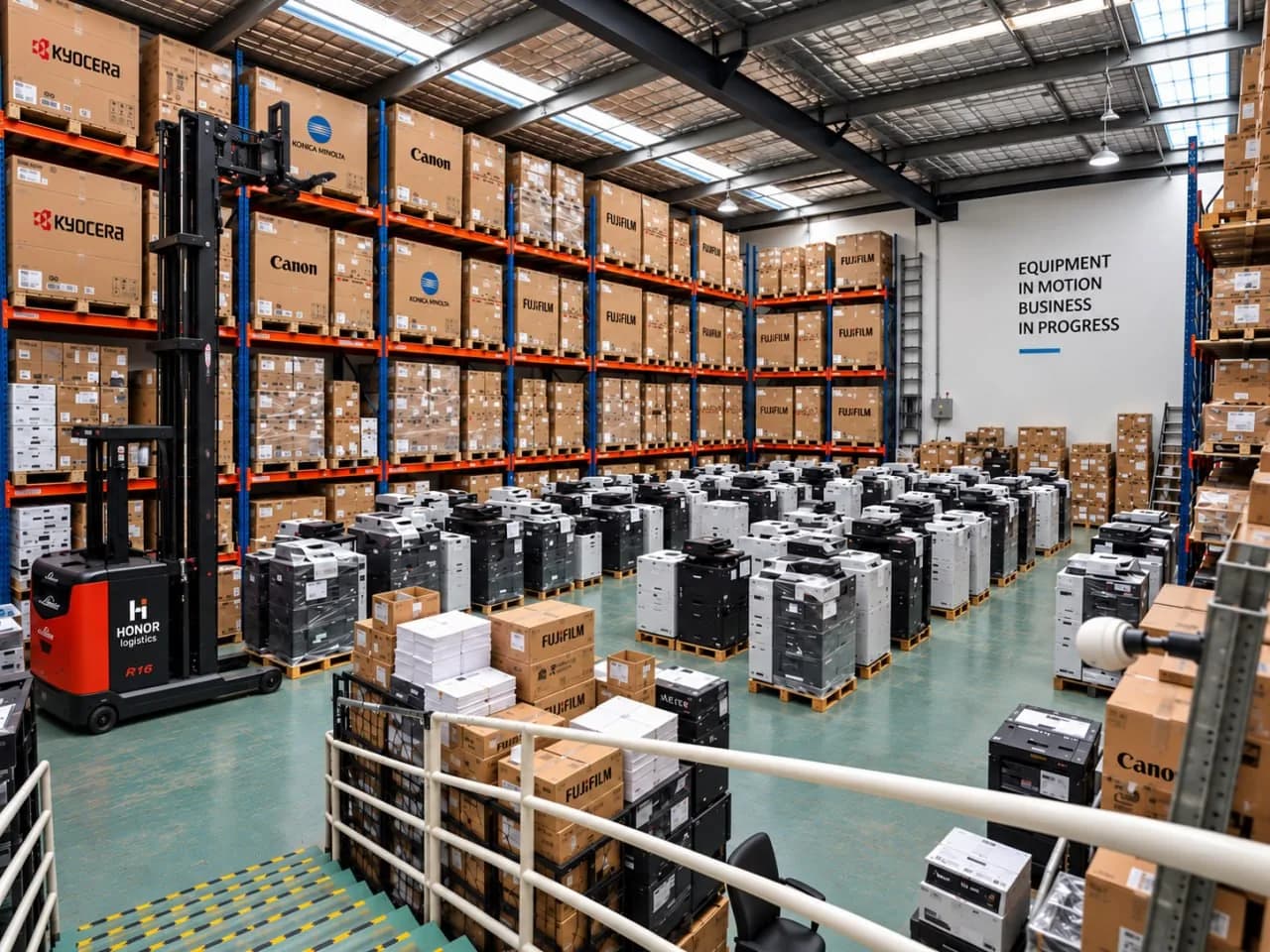
Wide format relocation.
Wide-format equipment fails on geometry before it fails on weight. The machine is longer than the lift, wider than the door and hung with assemblies that do not tolerate being leaned on — so the measurement happens before the booking, not on the morning.
- COVERAGE
- NSW · ACT
- SCOPED FROM
- SITE SURVEY
- RUN UP
- USUALLY ON SITE
Five constraints, all of them dimensional.
A wide-format move is a fitting problem before it is a lifting problem. These are what get measured, and each one has cancelled a move that was booked without them.
Dimensions against the building
Machine length and width against door widths, corridor turns, lift car depth and lift door height. The constraint is almost never the loading dock — it is a 90-degree turn two floors up.
Whether it comes apart, and who does it
Some wide-format equipment leaves a room in one piece and some does not. Which parts come off and in what order is settled on the survey — and Honor's own technicians do the stripping and the rebuild, so the crew putting it back together is the crew that took it apart.
Fragile assemblies
Print heads, rails, take-up assemblies and media handling are the parts that do not survive being used as a handhold. They are identified on the survey and protected before the machine is touched, not once it is on the trolley.
The receiving environment
Where it lands, what it plugs into, what clearance it needs behind and beside it for media loading and service access. A machine set 200mm too close to a wall is a machine that has to be moved twice.
The production window
Wide-format is usually running live work. The move is sequenced around what is on the machine, so it comes down after the job it is committed to and goes back up before the next.
The measurement happens before the booking, not on the morning.
METHOD
Measured, protected, moved, positioned.
Four steps rather than seven. A wide-format move is shorter than a production print project, and the compression is honest — the survey still carries it.
Measure both ends
Machine, route and destination measured and recorded. Anything that does not fit is identified here, while it is still a plan rather than a problem.
Protect and prepare
Fragile assemblies identified on the survey are protected first. Anything removed to clear the route is logged as it comes off so it goes back the way it came apart.
Move under custody
Logged out with the serial recorded, moved on a planned run, logged in on arrival. Held at Mortdale with a pallet location if the receiving room is not ready.
Position and hand over
Set in the surveyed position with the clearances it needs, reassembled, and signed for by name, role, date and serial.
What buyers ask us.
- Do you move wide-format printers?
- Yes — every make and model, with full service capability. The move is quoted from measurements taken at both ends rather than from the machine's model number, because on wide format the building is the constraint more often than the equipment is.
- What happens if the machine does not fit the lift?
- It is found on the survey rather than on the day. The options — stripping the machine down further, a different route, or an external lift — are priced and agreed before the date is booked, because each one changes the crew and the window.
- Will you recalibrate it once it is in place?
- Yes. Wide-format machines are usually run up and installed on site rather than at the bench, so configuration and commissioning happen in the room the machine will work in — and it is Honor's technicians doing it, not a service agent booked in afterwards.
- Can you work outside production hours?
- Yes, on request. Wide-format moves are usually scheduled around live production, so the run is planned to the window rather than the window to the run. Out-of-hours and weekend work is charged at the standard day rate plus 50%.
- Do you move the media and consumables too?
- Yes. Roll stock, media and consumables travel on the same run rather than being left for someone else to shift, and are logged in against the same record as the machine.
The operations behind this work.
This is an equipment class, not a department. These are the parts of Honor that actually run it.
The rest of what Honor moves.
How can we help you?
Tell us the sites and the machine count. We will come back with a scope, a schedule and a price, not a brochure.
Pick the one closer to your job and we will tailor the response.
Hours / Mon–Fri, 7:30am – 4pm
After hours / Available by arrangement